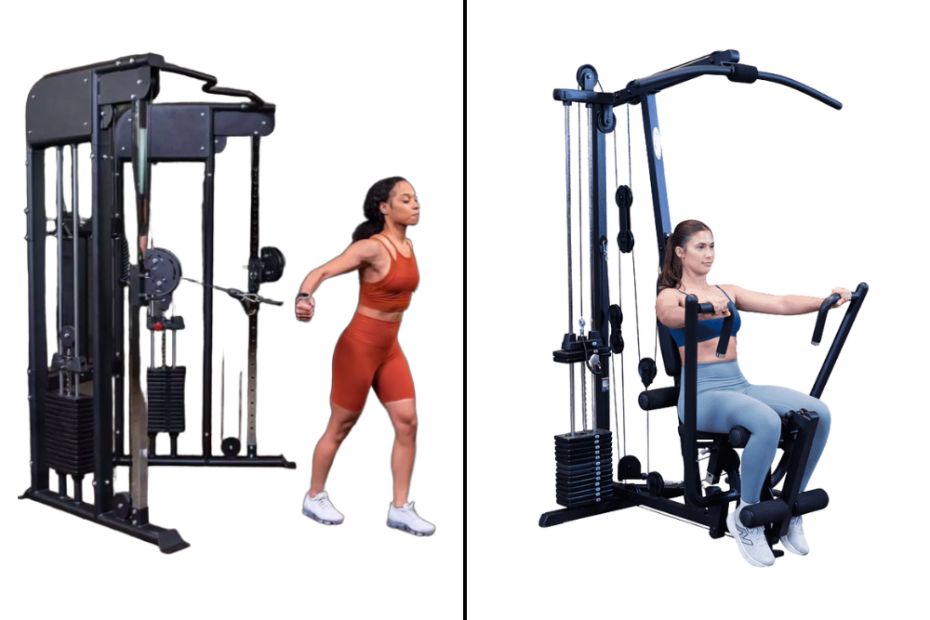
If you want to strength train at home but are deciding between a functional trainer and a traditional home gym, the right choice largely comes down to how you prefer to exercise. A functional trainer gives you adjustable cable pulleys and enormous exercise variety. A traditional home gym provides more fixed exercise stations and a guided setup that can feel simpler to use.
Neither is automatically better for everyone. For women building a serious home strength-training setup, I particularly like two Body-Solid options: the GFT100 Functional Trainer and the G3B Multi-Station Home Gym. They are both substantial strength machines, but they provide very different workout experiences.
Here’s how they compare.
Functional Trainer vs Home Gym: Quick Comparison
| Body-Solid GFT100 Functional Trainer | Body-Solid G3B Home Gym | |
|---|---|---|
| Best for | Exercise variety and cable-based training | Guided, traditional strength training |
| Resistance | Dual 160 lb weight stacks | 160 lb selectorized weight stack |
| Weight-stack upgrades | Dual 210 lb or dual 310 lb | Upgradeable to 210 lb |
| Pulley system | Two fully adjustable swiveling pulleys | Fixed exercise stations and pulley positions |
| Training style | Highly versatile and customizable | Structured and straightforward |
| Upper-body exercises | Cable-based multi-angle training | Fixed stations, fixed cable pulley |
| Lower-body exercises | Cable-based lower-body training | Built-in leg extension/leg curl, cable movements |
| Pressing exercises | Cable presses | Dedicated multi-grip press arm |
| Attachments | Multiple attachments included | Multiple attachments included |
| Dimensions | 45″L × 64″W × 83″H | 80″L × 47″W × 84″H |
| Machine weight | 633 lb | 340 lb |
| Best choice if… | You want maximum exercise versatility | You want traditional gym-machine simplicity |
| Take a look | 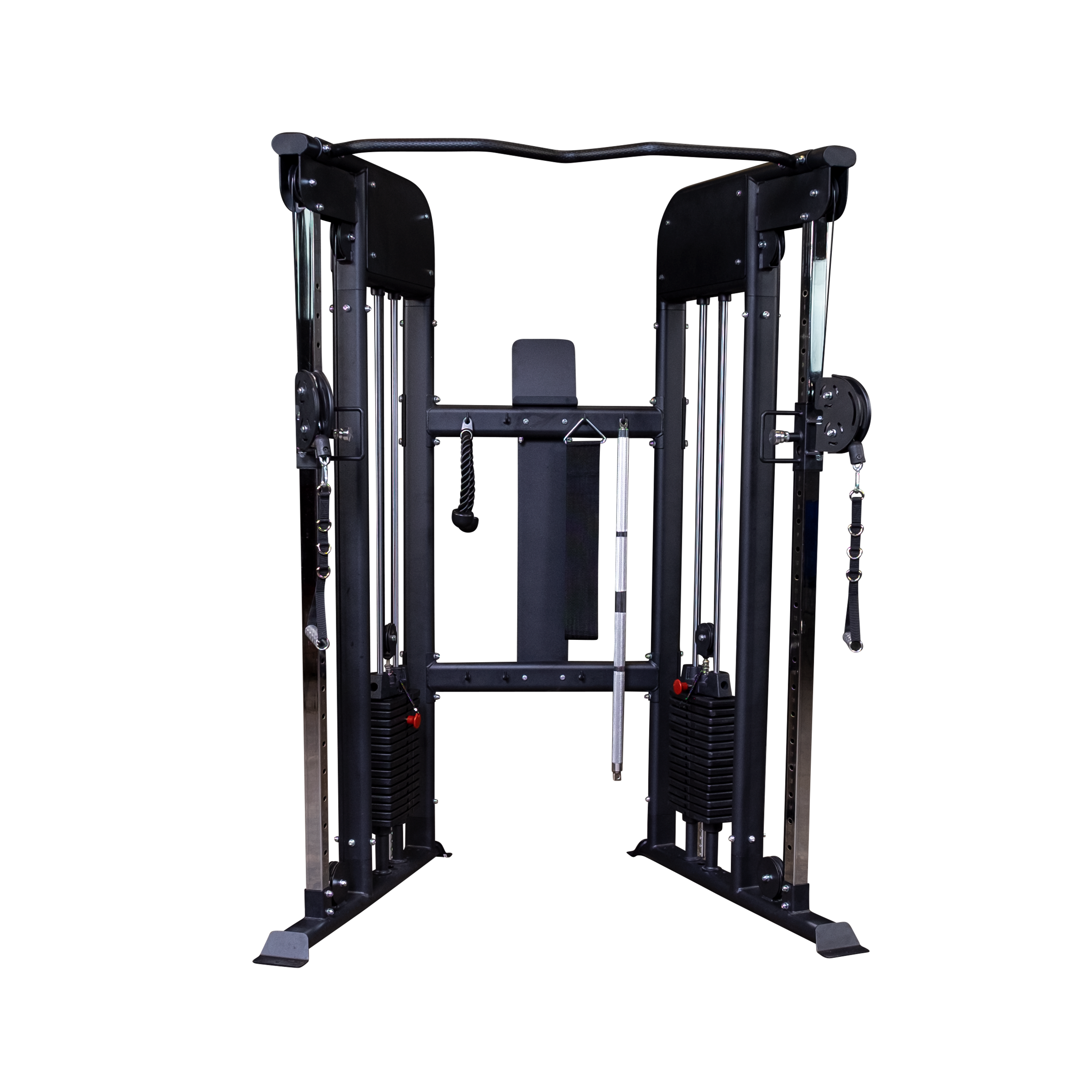 | 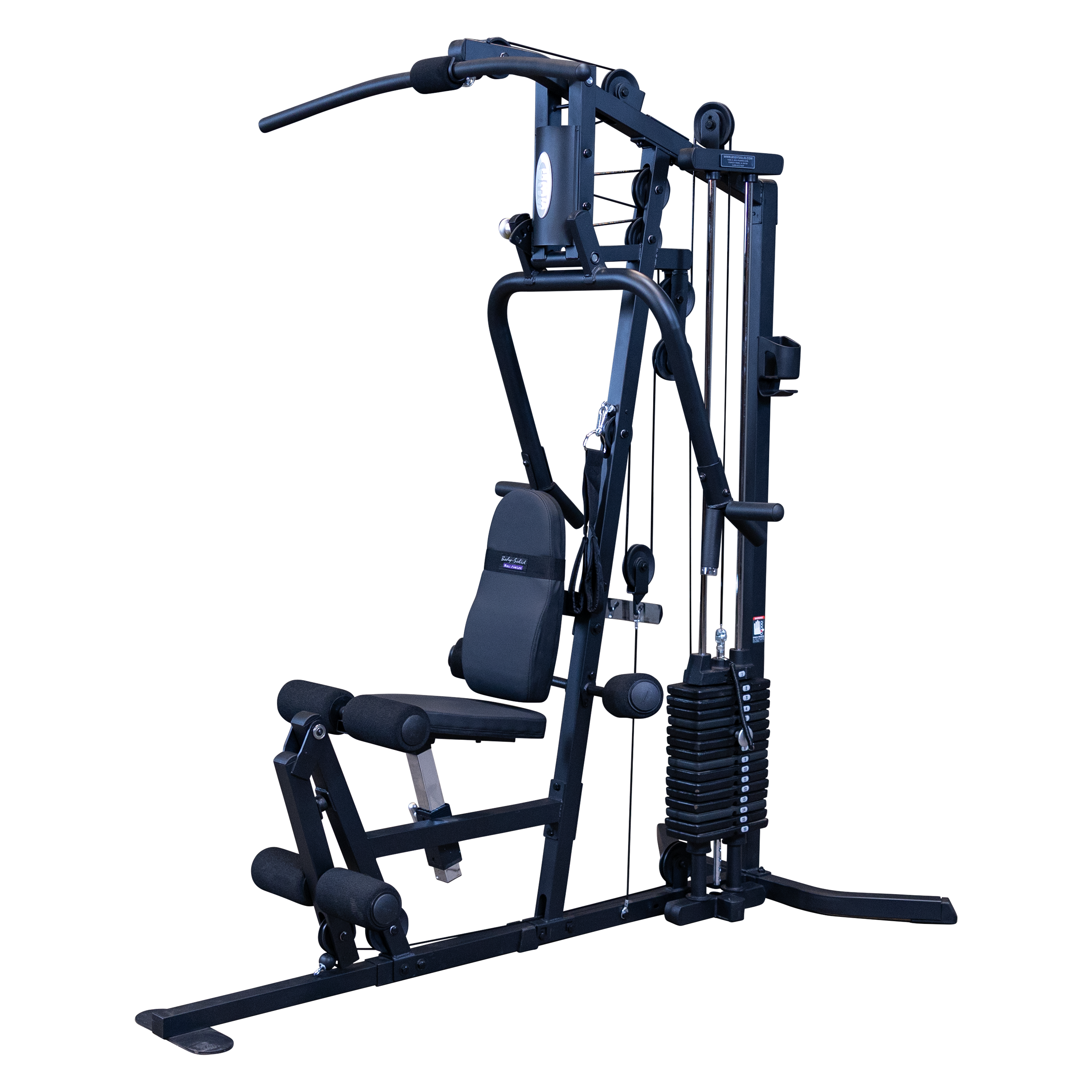 |
What Is a Functional Trainer?
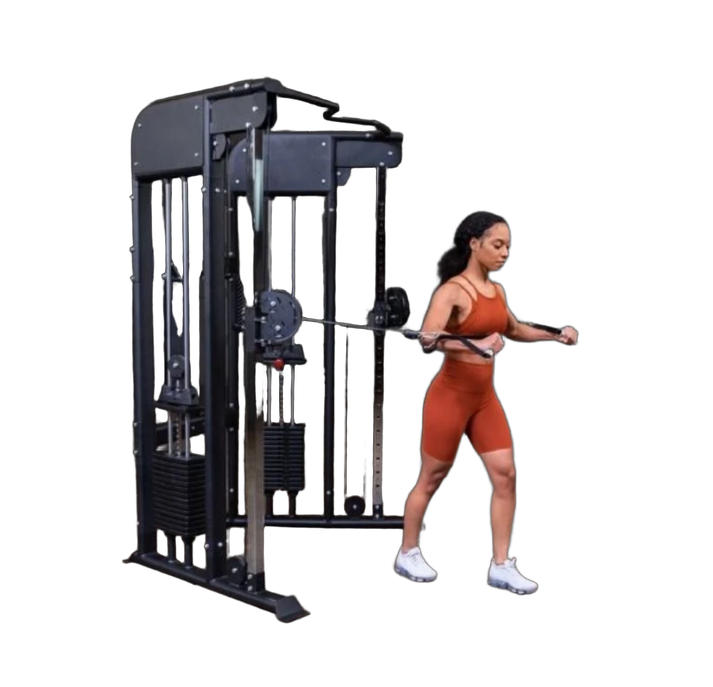
A functional trainer uses adjustable cable pulleys connected to weight stacks. Instead of sitting at a fixed station that determines exactly how you move, you reposition the pulleys and choose your own attachments depending on the exercise. That makes a functional trainer extremely versatile.
With a machine such as the Body-Solid GFT100, you can perform countless exercises, including cable rows, chest presses, fly variations, lateral raises, triceps exercises, biceps curls, squats, lunges, glute exercises, core, and many more. It also includes an integrated chin-up bar for upper body and core training, along with several useful cable attachments that maximize its exercise versatility.
The GFT100 has two independent 160 lb weight stacks and fully adjustable swiveling pulleys, allowing you to train from numerous angles using one pulley, or both together. Each pulley features an easy-pin system so you can set the pulley higher or lower according to the movement you want to perform. The stacks can also be upgraded to dual 210 lb or dual 310 lb stacks allowing room for long-term strength and fitness progress.
Who is a functional trainer best for?
I would choose a functional trainer if you:
- Want an enormous variety of exercises
- Want to train your whole body with one cable system
- Want the option of changing angles and exercise positions
- Want more freedom in how exercises are performed
- Already have some strength-training experience or are comfortable learning new exercises
- Want a machine you are unlikely to outgrow
- Values the option of using a workout bench for added versatility (bench not included)
For someone who enjoys variety, the functional trainer is difficult to beat.
What Is a Traditional Home Gym?
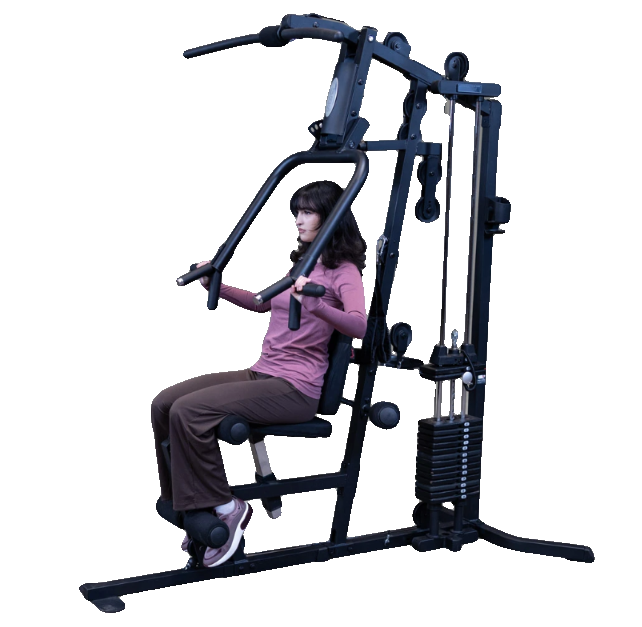
A traditional home gym takes a more structured approach. Rather than continually repositioning cable pulleys, you have dedicated stations or movement patterns for many of the major exercises.
The Body-Solid G3B, for example, includes a multi-grip press arm for chest, incline and shoulder pressing, mid-row handles, lat pulldown capability and an adjustable leg extension and leg curl station. It uses one 160 lb selectorized weight stack, which can be upgraded to 210 lb, so there’s room to progress your strength and fitness.
This makes it particularly attractive for someone who wants to walk over to the machine, select a weight and begin exercising without setting up a new cable position for every movement.
Who is a home gym best for?
I would choose a traditional home gym if you:
- Prefer clearly defined exercise stations
- Want a machine that feels intuitive and straightforward
- Don’t require extensive exercise variety
- Like traditional gym-machine exercises
- Want dedicated chest, back and leg movements
- Don’t want to continually reposition pulleys
- Prefer a more guided training experience
For many women building their first substantial home gym, this simplicity can be a major advantage.
GFT100 vs G3B: Which Gives You More Exercises?
The Body-Solid GFT100 wins for sheer exercise variety. Because its pulleys can be moved vertically and swivel to different angles, you can create an enormous number of exercise variations. You can also add an adjustable workout bench such as the Body-Solid GFID225B for even more versatility.
You aren’t limited to the movement pattern built into the machine. For example, the pulley system can be used for:
- Cable squats
- Romanian deadlift variations
- Glute kickbacks and various leg isolation movements
- Rows
- Chest presses
- Cable flyes
- Shoulder exercises
- Biceps curls
- Triceps extensions
- Core exercises
The Body-Solid G3B still provides a very comprehensive full-body workout, but the exercises are more structured around the machine’s stations.
Winner for versatility: GFT100
Which Is Easier to Use?
This is where the G3B has an advantage. A functional trainer gives you more freedom, but more freedom also means you need to know where to position the pulley, which attachment to use. and how to position your body correctly.
The G3B does more of that thinking for you. If you want to train your chest, for example, there is a dedicated press arm. If you want leg extensions, there is a dedicated leg station.
That can make the G3B particularly appealing to someone who needs more exercise form guidance, or doesn’t want every workout to involve changing cable positions and attachments.
Winner for simplicity: G3B
Which Is Better for Lower-Body Training?
This one depends on the type of lower-body training you prefer, but a significant difference is that the GFT100 provides both compound and isolation movements, whereas the G3B is isolation-focused.
The G3B multigym includes a dedicated adjustable leg extension and leg curl station, which is a convenient feature for some women as it offers comfortable and guided quadriceps and hamstrings training. The G3B also features a fixed low cable pulley that attaches to it’s included ankle attachment, so you can perform various leg movements. But these are also typically isolation movements.
The GFT100 doesn’t give you the same fixed-machine leg curl station, but its cables and included attachments allow for considerably more lower-body exercise variety, including compound movements. You can use it for exercises such as squats, lunges, hip-focused movements, and numerous other cable-based leg exercises.
So I would divide this one like this:
For dedicated leg-machine exercises: G3B
For lower-body exercise variety: GFT100
Which Is Better for Upper-Body Training?
Both are excellent, but again they approach it differently. The G3B provides dedicated pressing, rowing and pulldown movements. Its multi-grip press arm can be used for chest, incline and shoulder pressing, while the lat pulldown and rowing positions cover the back.
The GFT100 lets you recreate these exercises using cables while also offering considerably more variations on top of that.
If you desire different cable angles, as well as bilateral and unilateral exercises – training one side at a time – the GFT100 gives you much more freedom.
If you’d rather have the machine establish the movement for you, the G3B is simpler.
Which Takes Up Less Space?
Interestingly, the answer isn’t quite as obvious as you might expect.
- The GFT100 measures approximately 45 inches long × 64 inches wide × 83 inches high.
- The G3B measures approximately 80 inches long × 47 inches wide × 84 inches high.
So the GFT100 is substantially shorter front-to-back but wider. And the G3B is narrower but considerably longer.
You also need usable space around either machine to exercise comfortably, so don’t choose based purely on the listed footprint. Measure the actual area where you intend to train and think about the space required to move around the machine.
Which Is Better for Women Over 40 or 50?
The machine itself doesn’t need to be specifically designed for a particular age. What matters much more is whether it gives you a practical way to perform progressive resistance training consistently.
Strength training becomes particularly valuable as we get older because maintaining muscular strength supports everyday function, mobility and independence. And during menopause resistance training is particularly important for maintaining bone and joint health.
Both machines provide progressive resistance training. The better choice is therefore which one you are realistically going to use.
If you love variety and want dozens of cable exercise options, I would lean toward the Body-Solid GFT100.
If you prefer a straightforward machine where the exercises are already laid out for you, I would lean toward the Body-Solid G3B.
What About Free Weights?
You don’t necessarily have to choose one or the other. I have worked with women for more than 20 years as a Personal Trainer, and I generally prefer having different forms of resistance training available rather than relying on one single tool.
Either of these machines can form the foundation of a very good home strength setup. You can then add dumbbells, an adjustable bench or resistance bands later if you want even more training options.
Body-Solid GFT100: Best for Maximum Versatility
I would choose the Body-Solid GFT100 Functional Trainer if you want the more versatile of these two machines.
Its major advantages are:
- Dual independent weight stacks
- Fully adjustable swiveling pulleys
- Huge range of possible exercises
- Numerous cable-training angles
- Bi-lateral and unilateral training
- Integrated chin-up bar
- Upgradeable weight stacks
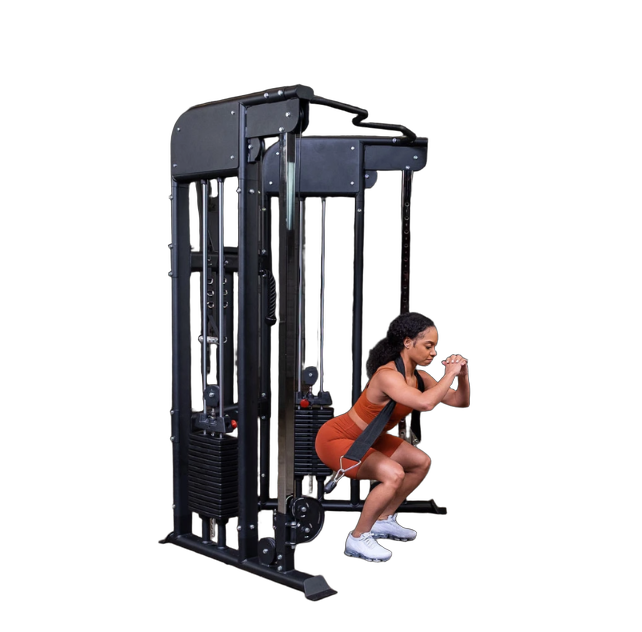
It is especially attractive if you already enjoy cable exercises or want one machine that allows you to continually change your workouts.
Shop the Body-Solid GFT100 Functional Trainer
Body-Solid G3B: Best for a Traditional Home Gym
I would choose the Body-Solid G3B Home Gym if you want a more guided strength-training experience.
Its major advantages include:
- Dedicated multi-grip pressing station
- Lat pulldown exercises
- Mid-row handles
- Built-in leg extension and leg curl
- Selectorized resistance
- Straightforward exercise setup
- Fixed cable movements
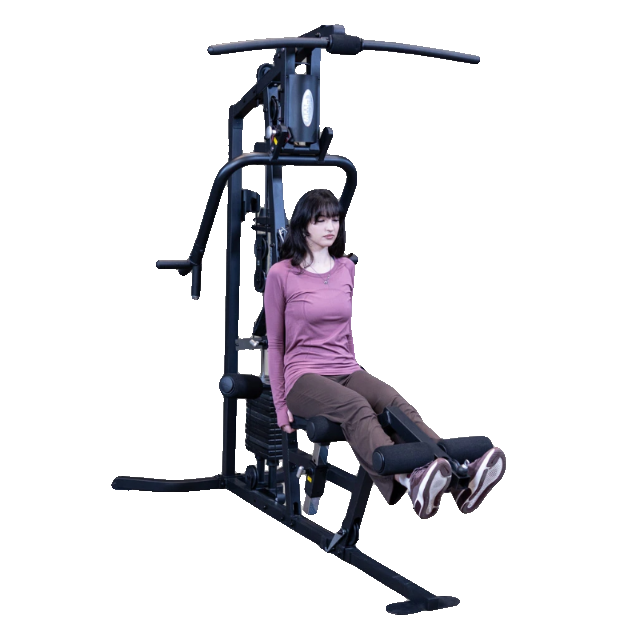
For someone who wants a substantial home strength machine without having to configure adjustable pulleys for every exercise, the G3B is an excellent choice.
Shop the Body-Solid G3B Home Gym
Functional Trainer vs Home Gym: My Recommendation
If I had to reduce the decision to one question, it would be: Do you value versatility or simplicity more?
Choose the Body-Solid GFT100 Functional Trainer if you want the greatest range of exercise possibilities and like the freedom of cable training. Choose the Body-Solid G3B Home Gym if you prefer defined exercise stations and want a more traditional gym-machine experience. Neither is the universally better machine.
For an experienced exerciser who wants maximum variety, I would give the GFT100 the edge. For someone who is new to exercise or just wants a straightforward, comprehensive home strength system with dedicated exercise stations, I would choose the G3B.
Either can become the centerpiece of a serious home strength-training setup – the important part is choosing the style of training you will actually enjoy using consistently.